
Something's Missing
Why church on Sunday doesn't translate to Monday

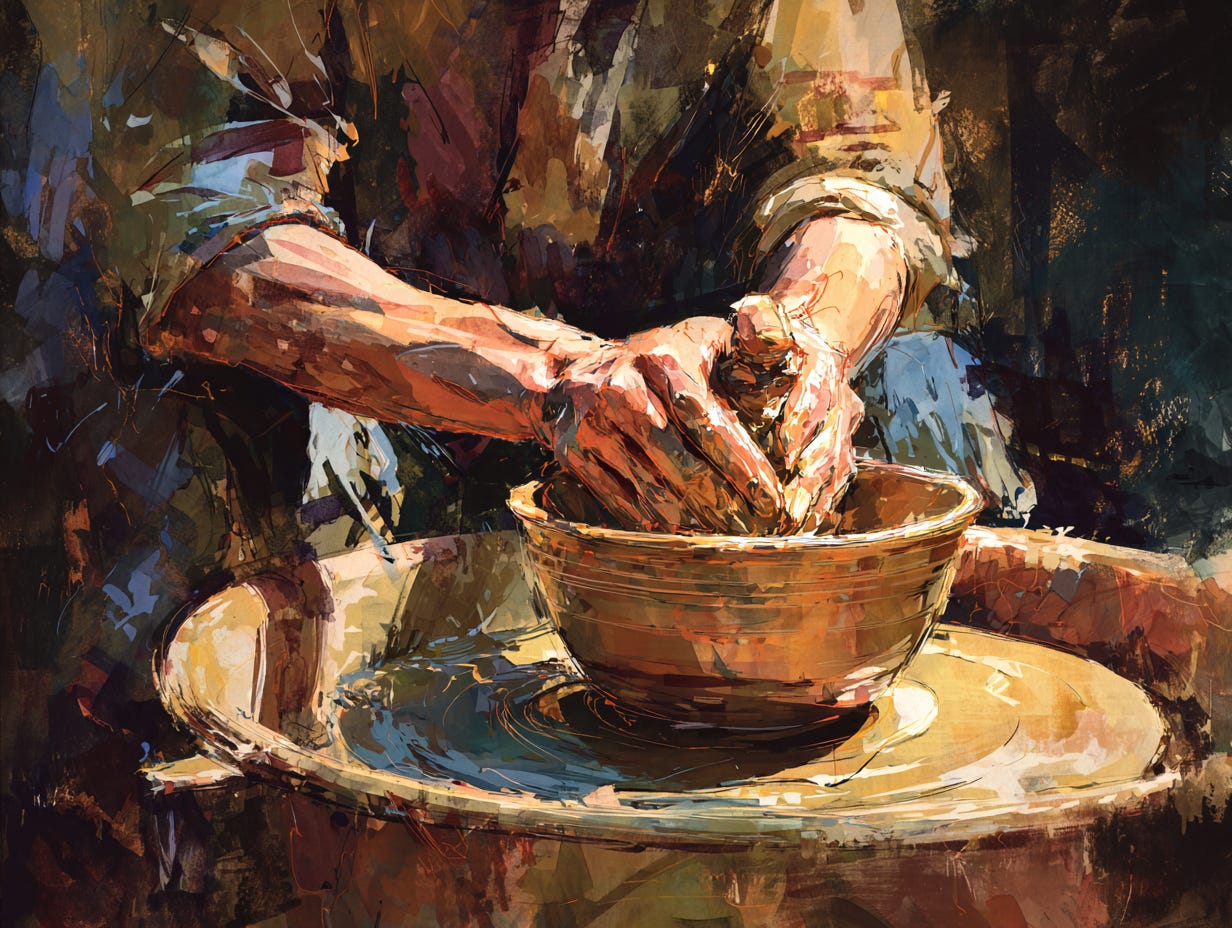
“Yet you, Lord, are our Father. We are the clay, you are the potter; we are all the work of your hand.”
Isaiah 64:8
It doesn’t take much to look around on Sunday and see that something’s missing. Despite the unparalleled access to Scripture, the countless resources available, and the safety to worship freely, there seems to be a disconnect between the message and many who hear it.
Church feels like ritual on repeat—familiar and comfortable, but they’re never moved from that comfort. Their knowledge of the Bible isn’t the issue. They know the stories, the traditions, the key passages.
Volunteering feels like busywork. These Christians show up and serve, but it doesn’t feel like there’s any formation as a result. They may not even feel like it should change them.
And often, this same hollow feeling shows up in another way. In quiet moments, away from the church building and the busyness of life, questions sneak in about confidence, salvation, and their relationship with Jesus. But they can’t quite put their finger on why.
To be fair, I’ve had moments that resemble this. I bet we all have.
How We Got Here
This isn’t rare. It’s not isolated to a few struggling individuals. The gap exists for reasons—some visible, some less obvious.
And I believe the dissonance people feel is pointing to something real—and it’s worth our attention.
Faith contained to Sunday morning
For many, faith has been compressed into one hour per week. They gather, sing, hear a lesson, leave. The rest of life goes on largely unchanged. Spiritual formation can’t happen in 60 minutes a week, a fact which seems to be hard to express.
Checklist Obedience
Faithfulness looks like a list: correct doctrine, attendance, giving, don’t drink, don’t curse, don’t miss communion, volunteer. As long as they complete the list and avoid major failures, they’re being obedient. But a list of behaviors can’t produce transformation. Every box can be checked while the point gets missed.
Teaching without depth
We’ve too often offered teaching that overemphasizes the simple and avoids the tough. Same passages, same lessons, same points year after year. The hard texts get skipped. The Old Testament gets ignored. Scripture gets treated like a highlight reel instead of a deep well.
Membership as the finish line
We’ve too often stressed membership as the end goal, striving for numbers instead of depth. This accomplishes initiation without formation. The call to sanctification that should continue indefinitely gets muted. Growing in Jesus gets relegated to what can be gathered through regular attendance and personal study.
These aren’t the only causes, but they’re patterns worth naming—and the culture surrounding us isn’t calling anyone to the fix.
What Fills the Gap
What fills the gap isn’t a program or a formula. It’s dedication to being a disciple.
But here’s the thing: it’s our responsibility as a church to show people what that looks like. To disciple them, not just initiate them.
Dedication—however small to begin with—starts to fill the bucket. And before you know it, the work of filling in the gap is doing itself. Habits form. Patterns deepen. What feels like effort becomes the rhythm of life.
We can help people focus that dedication in clear ways that have real payoffs.
Helping people engage Scripture honestly
Not just reading more, but reading deeper. We need to teach people how to listen to Scripture describe the expectation for us—not boundary lines to stay within, but shapes to be conformed into.
This means helping them read the tough texts. Understand the larger context. Enter the parts they’ve been avoiding. Letting Scripture master them instead of trying to master it.
Helping people assess how they view themselves in relation to the world
The words we use shape how we think. How we define “Christian,” “disciple,” “kingdom,” “faith,” “salvation”—these categories determine how we live.
Some of the vocabulary we’ve inherited is shallow or distorted. We need to help people recover richer language that aligns with Scripture and calls them into deeper formation.
Helping people put what they learn into practice
Knowledge without transformation isn’t discipleship. This is about becoming like Jesus, not just knowing the Bible.
It’s about embodying what we’re learning—allowing it to reshape our decisions, our habits, our character, and our relationships. And we need to show people what that looks like.
What This Newsletter Is (and Isn’t)
Nothing written here is going to be the complete answer. But I hope it can help.
My goal is to help us ask better questions. Give us categories we’ve been missing. Challenge assumptions we’ve inherited. Grow together.
I’ve committed on a weekly basis to encourage us collectively to:
Read Scripture with greater depth and honesty
Recover vocabulary that shapes how we think about faith
Grow as disciples, not just as believers who know the right things
This isn’t a devotional. It’s not tips for better Christian living. It’s not going to flatter our tradition or attack it. It’s going to honor what’s good and challenge what’s shallow. And it’s going to ask us to do the same.
The Beauty of the Journey
The journey to find the solution is the solution.
The Bible itself continually provides what we need wherever we’re at and wherever we find ourselves along the journey. It meets us in our confusion, our doubt, our longing. It shapes us slowly, steadily, if we give it space to work.
The gap you’re seeing—the hollowness, the questions, the sense that something’s missing—isn’t fatal for the Christian or the church. But it helps us locate where transformation can begin—and that’s not a problem, it’s an invitation.